

Cleo Pro: Where We’re Headed
The problem we solve
Home repair breaks down in two places: figuring out what the work is, and getting someone to actually show up and do it. Cleo Pro exists to close both gaps.
Gap 1: the customer is made to scope the job. Most platforms ask the customer to diagnose the problem before anyone helps: square footage, number of rooms, how many stories, how wide. Most customers don’t want to do that, and many don’t know how. They want to say what’s wrong and have someone qualified figure out the rest. A customer may only know: “The cabinet over my microwave is falling apart and I need it fixed.” Dimensions, mounting method and water damage are a professional’s job to assess, not theirs.
Gap 2: “yes” doesn’t mean someone shows up. When a request comes in, it’s usually needed now: something broke. Even after a price is agreed, getting a person on site means finding who’s free, texting, waiting, renegotiating, confirming, reminding, checking whether they’re on the way and replacing them when they fall through. Doing that for one job is annoying. Doing it for ten jobs a day is a second full-time job, which is why so many contractors give up on it.
What Cleo Pro is: a managed service marketplace
Cleo Pro sells responsibility for the outcome, not access to contractors. Contractors are easy to find through Google, Thumbtack or a neighbor, and AI will make it easier still. What’s scarce is someone who owns the job until it’s done.
The business model decides whose problem a platform is paid to solve:
- Lead marketplace: customer submits a request, vendors get the lead, the platform gets paid. Whether anyone shows up or the work gets done can be secondary.
- Cleo Pro: the customer has a problem, Cleo takes responsibility, the work is completed successfully, then Cleo gets paid.
The promise to the customer: Tell Cleo Pro what you need. We figure out the scope, find the right professional, coordinate the appointment, track the work, verify completion and stand behind the job. Compare that with “here are five contractors who might help you,” which hands the customer another project to manage.
Taking responsibility costs something. Cleo inherits risks a lead marketplace avoids: qualified technicians, no-shows, damage, repairs that fail two weeks later, disputes, callbacks and documentation. Poor workmanship does not scale: a 5% serious-failure rate is 2 or 3 jobs out of 50, but 2,500 out of 50,000. So Cleo has to be excellent at controlling quality, not just at dispatching people.
Principle 1: The customer describes the problem. Cleo figures out the work.
The request stays short on purpose. It asks for just enough that the customer doesn’t feel they’re doing the work, and enough for Cleo to understand what needs to happen:
- What happened or what they need: tap a service, or one sentence.
- Where: the address, and whole house or certain areas.
- Show us (optional): photos or a short video.
- When: ASAP, this week, or a time they pick.
From there Cleo takes responsibility for turning that into a scope. Example: “My microwave fell down. The bottom of the cabinet looks rotten. I need the cabinet fixed and the microwave put back.” Cleo opens request #001 Cabinet/Microwave Repair, ties the customer and every message to it, reads the description and photos, identifies the likely trades and materials, and decides what information is still truly needed.
Cleo also decides how much friction each job needs. Some jobs can be quoted from two photos. Some need a short video, some need one follow-up question, and some need a person standing there. The detailed measuring (window sizes, ceiling heights, square footage) happens on the vendor’s site-visit form, never on the customer’s request.
Principle 2: An approved job becomes a dispatch problem, not another task for the contractor
Once the customer approves the price, Cleo moves the job to completion on its own. The industry treats booking as the finish line, but between “customer approves $475” and “a qualified person arrives Tuesday at 10 am and does the work” sits all the coordination nobody wants to do.
Cleo handles it:
- finds a qualified provider and checks they’re available
- offers the job and gets a commitment
- sets the arrival window and confirms it with the customer
- reminds the provider and verifies they’re on the way
- escalates when they’re late or not answering
- finds a replacement when the first provider falls through
Commitment, not competition. Cleo doesn’t broadcast “a homeowner needs a plumber, who wants the lead?” The hard front-end work is already done, so the offer reads like this:
Job #001, Water Heater Replacement. Scope set, photos attached, customer approved $X, location confirmed, customer availability confirmed, payment authorized. Can you commit to this job?
Cleo doesn’t need five people competing for one customer. It needs one qualified person who will commit.
Quality: verification sized to the job, territory managers, one record per job
Verify by risk, not by default. A $175 repair can’t pay for a dispatcher, a technician and a separate inspector driving out. So Cleo decides how much proof each job needs:
| Job | Proof required |
|---|---|
| Small drywall patch | Timestamped before/after photos, technician checklist, customer confirmation |
| Cabinet repair holding a microwave | More photos plus specific installation checks |
| $15,000 renovation | Independent physical inspection before final payment |
Territory managers handle exceptions. A territory manager is a local operations manager who owns outcomes for an area, not an inspector who visits every job. Software does the volume work: customer messages, tracking, reminders, collecting documents, scheduling, alerts, payment status and routine checks. When a job’s photos and checklist are complete and the customer confirms, it closes on its own. When something is off (a required photo is missing, the customer reports moisture around the unit, or a job is still open four hours past its expected finish), it goes to the territory manager for review. One manager can oversee many jobs because they only spend time on the ones showing signs of trouble. This turns the responsibility Jack provides in person today into a system that works without him being everywhere.
The request number is the record of the job. Everything for #001 lives under #001: request, photos, scope, estimate, approval, provider, arrival, work performed, before/after photos, checklist, customer confirmation, payment, guarantee period, close. If something goes wrong three weeks later, nobody rebuilds the job from texts and memory. Cleo knows who did it, what was authorized, which materials were specified, when the technician arrived, what they said they finished, what the customer accepted and which guarantee applies. That chain of accountability is something lead marketplaces don’t have in the same way.
The Cleo Pro Workmanship Guarantee
Cleo stands behind completed work with a defined guarantee that’s included in the price, not sold as an add-on. The customer stops wondering “what happens if this contractor disappears?” because their relationship is with Cleo, and Cleo deals with the provider afterward. That transfer of risk is part of what the customer pays for.
- Defined, not unlimited: written coverage, exclusions, duration, claim steps and the provider’s responsibility.
- Funded from a reserve: Cleo sets aside a percentage of every completed job for callbacks and claims. With volume, real costs replace guesses. Illustration: 10,000 jobs worth $5 million with $75,000 in remediation means a 1.5% cost, and pricing follows from that.
- Quality becomes financial data: if Provider A’s remediation cost is 0.4% and Provider B’s is 7%, Cleo knows who is really expensive whatever their star rating, and that feeds straight back into dispatch.
The provider side: ready-to-perform jobs and a reliability record
Providers get work they can go perform, not leads to fight over. Cleo won’t rush into charging contractors for leads. Instead of “here’s a phone number, pay $40 and fight four contractors for it,” Cleo offers: Job #001, cabinet reinforcement and microwave installation. $X labor. Tuesday 10 to 12. Customer approved, address verified, scope and photos attached, payment secured. Accept or decline. That removes the contractor’s cost of finding customers, estimating, chasing, scheduling and often collecting.
Reliability is measured by behavior, not stars. Cleo keeps an internal record of what each provider actually does:
- jobs accepted vs. declined, and accepted-to-arrived rate
- on-time percentage, cancellations and response time
- completion rate, callbacks and guarantee claims
- customer issues and documentation quality
- successful jobs by service type
Someone who accepts 30 jobs and completes 29 properly is worth far more to Cleo than a polished profile with a 4.9-star rating. That creates a loop: reliable providers get first access to better jobs, earn more, commit more to Cleo, give customers a better experience, which brings more customers and more jobs for reliable providers. Providers who accept jobs and then stall customers move down the queue on their own.
The pipeline and how we measure success
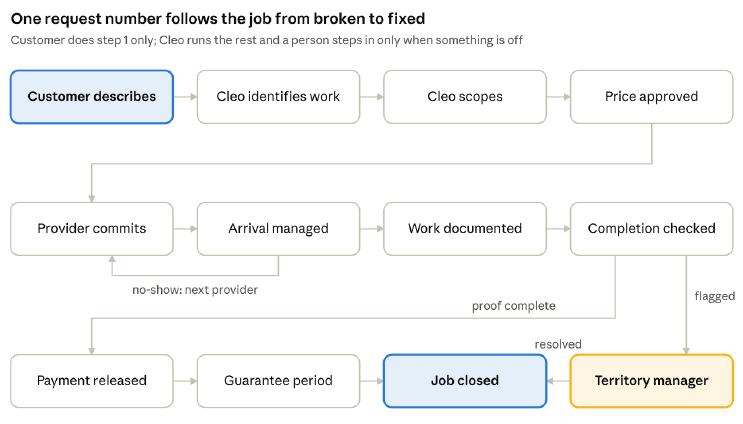
The customer only describes the problem; every later step belongs to Cleo, and a person gets involved only when a provider falls through or a job is flagged.
Success isn’t leads generated or even jobs booked. It’s one number: how quickly Cleo turns “I need this fixed” into “someone qualified is here fixing it,” with the least work for the customer and the contractor. Every request logs that time, so each change to the platform can be judged by whether it shortens it.
What makes Cleo Pro different
The category isn’t new; the combination is. “Managed marketplace” (also called end-to-end or full-stack) is an established term, and others already run versions of it in home services, such as Homevisor and Handy. What hasn’t become the standard is this combination, and it’s what we protect and develop:
- a minimal customer request
- AI-assisted scoping
- jobs that are pre-approved before a provider sees them
- commitment-based dispatch
- a reliability record built from behavior
- territory-level accountability
- verification sized to each job’s risk
- a Cleo workmanship guarantee
Customers get “handle this for me.” Providers get “work I can actually go perform.” Cleo gets paid for running the job and taking responsibility for the experience. The advantage isn’t a better contractor directory; it’s the operating system between “something is broken” and “it’s fixed.”
Roadmap
The platform already gets a pro to the door and tracks them there (version 1.3.2); the next four builds add triage, approval, dispatch and verification.
| Pipeline step | Today (1.3.2) | Gap |
|---|---|---|
| Customer describes | Built, but asks too much | Cut to the four-step request |
| Cleo identifies and scopes | Partly: AI scope polish, request numbers, “we received your request” messages | No triage, no photo reading |
| Price approved | Missing | No estimate or approval step |
| Provider commits | Partly: pay set per vendor, trip alerts, late alerts | No automatic offers, availability, replacement or reliability record |
| Cleo manages arrival | Built: live trip, automatic arrival, customer cancel/reschedule link | Tracking needs the trip page open on the phone |
| Work documented and verified | Missing | No photos, checklist or customer confirmation |
| Payment, guarantee, close | Basic: visit marked completed and payable | No guarantee period or close-out |
Each build works without the next, so value ships at every step:
- 1.4 Describe and triage: the four-step request; AI reads text and photos and picks the path (remote quote, one question, video, or inspection); start logging offers, acceptances and response times, plus the time from request to pro on site.
- 1.5 Estimate and approve: estimates from photos or the site-visit form; the customer approves (and pays a deposit if required) from their link.
- 1.6 Dispatch: “Available now” switch, commitment offers to the most reliable qualified provider, automatic confirmations and reminders, automatic replacement, the reliability record, and one board for running many crews.
- 1.7 Verify and guarantee: verification sized to risk, before/after photos and checklists from the Cleo Pro app, customer sign-off before payment, the territory manager queue, the guarantee and its reserve.
Open question: what labor price, deposit and guarantee terms Cleo sets, and who reviews the guarantee wording.